
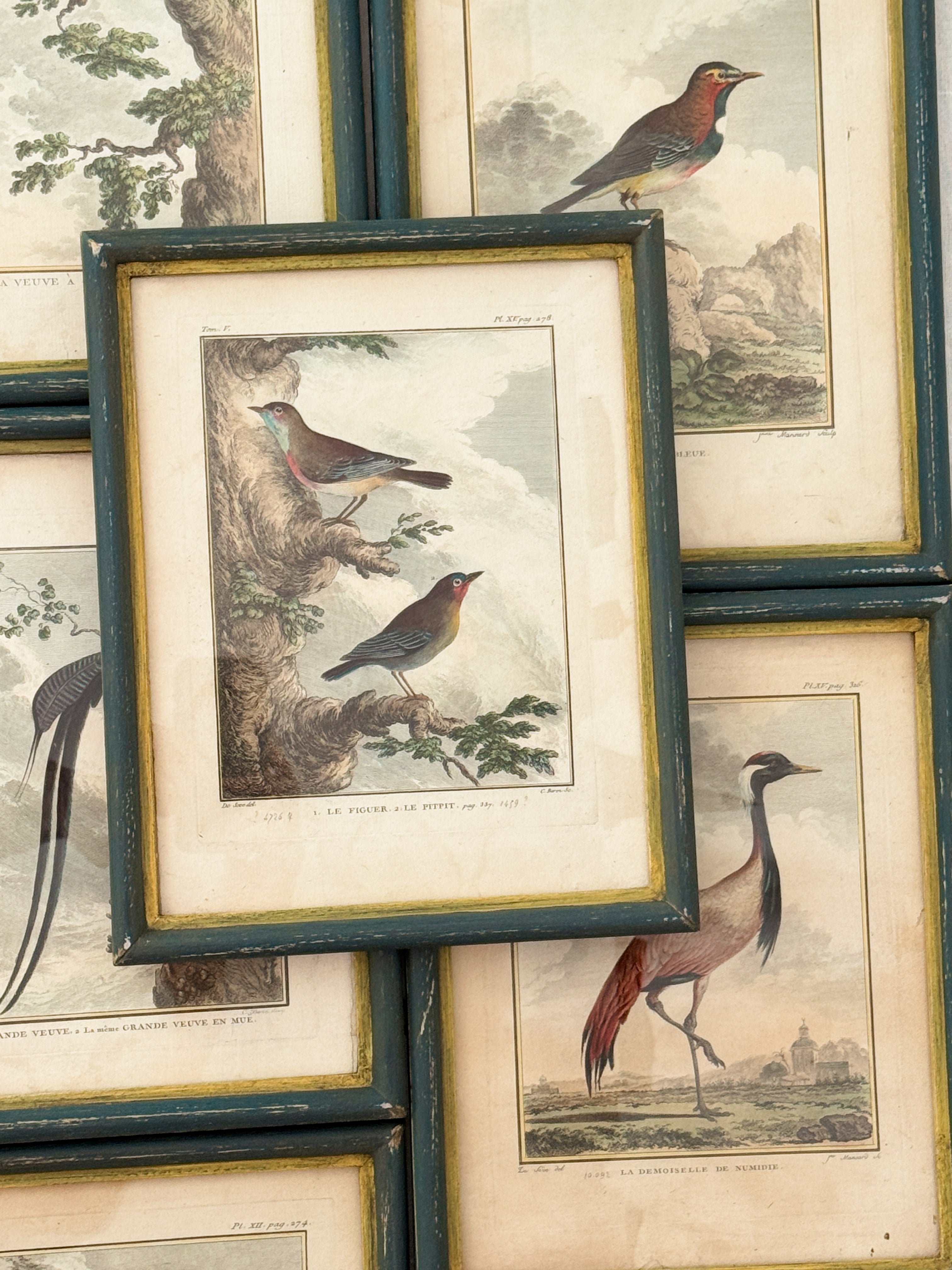
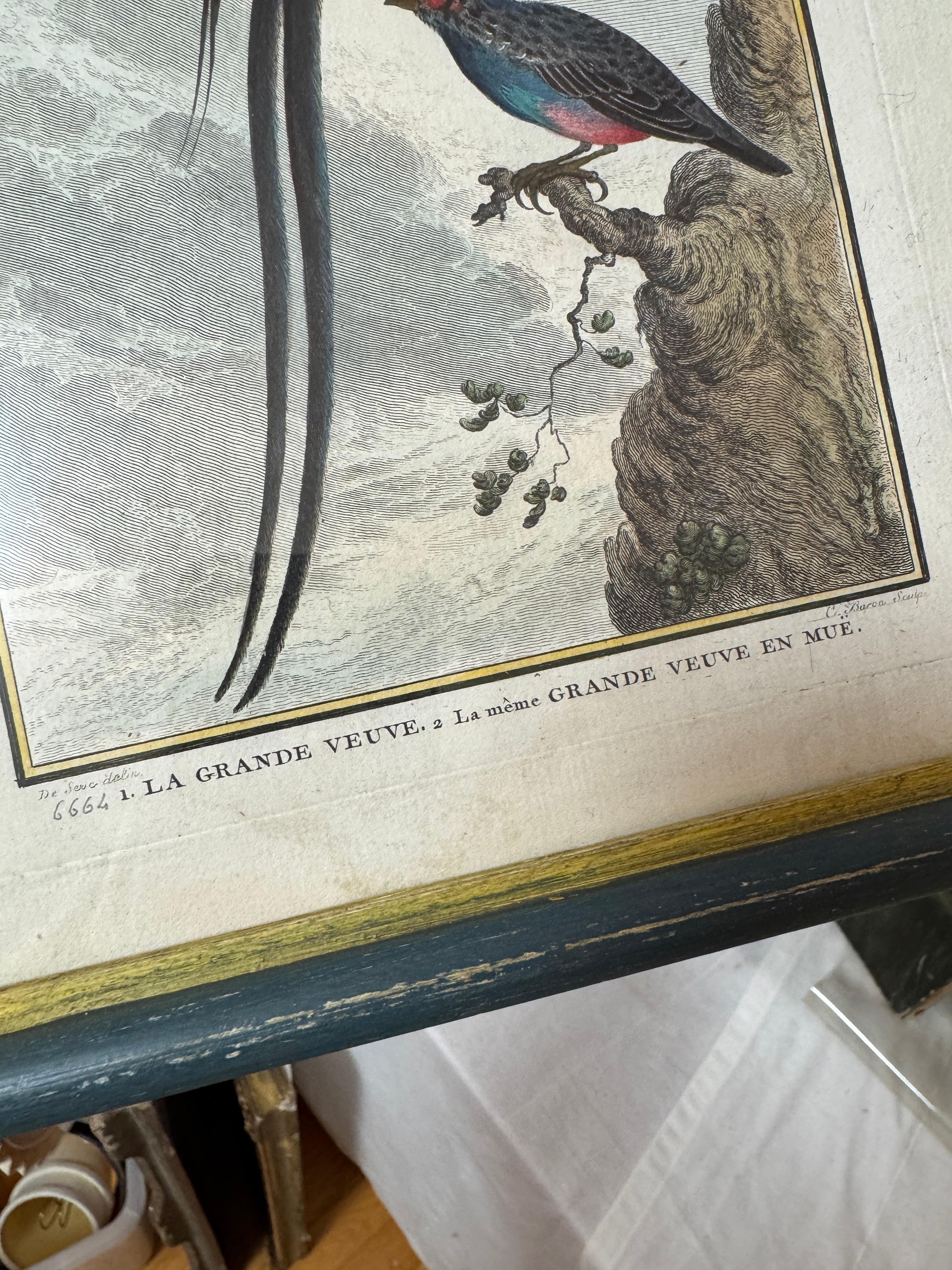
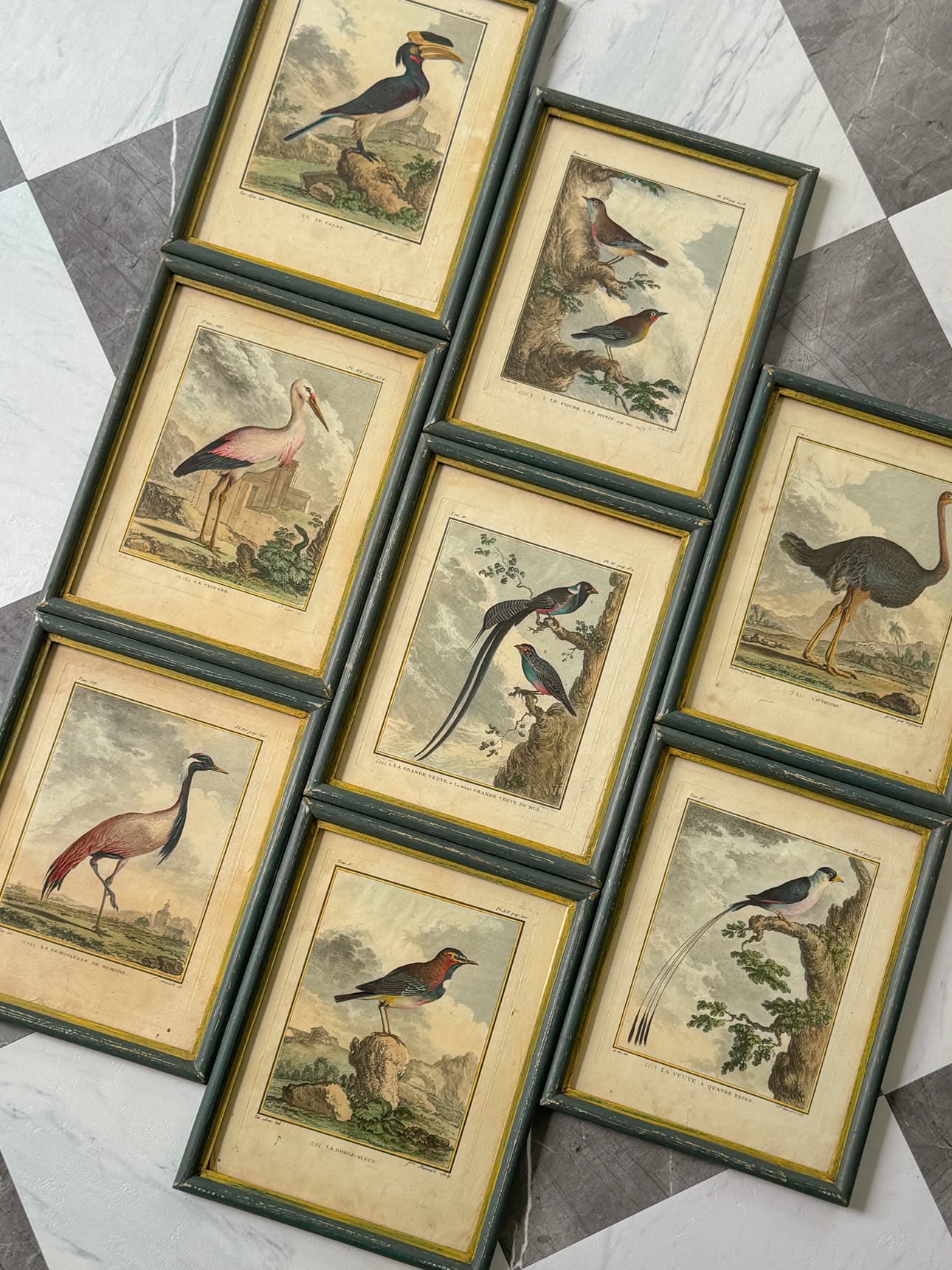
Antique French de Buffon Bird Engraving, Le Figuier et Le Pitpit, Hand Colored, 18th Century
Period
1770 to 1783, French
Size
9¼ x 11½ inches, framed
A hand colored copperplate engraving of two small birds on one plate, from Buffon's Histoire naturelle, drawn by Jacques de Sève and engraved by C. Baron. Marked pg. 337, pl. 1459.
Two birds are perched on a branching bough that runs up the left of the sheet, the upper one turned away in olive and buff, the lower one facing out with a dark head and a rust breast. Small clustered leaves are drawn along the branch, and a bank of cloud behind is left in engraved line with almost no color, so the two birds carry all of it.
The paper has warmed to ivory with scattered foxing through the margins. The frame is painted blue gray with a yellow ochre inner fillet, distressed to bare wood at the corners and along the rails. Sold as found.
Historical Context
Figuier, the fig eater, was Buffon's catch-all for the small warblers, and pitpit for a group of tanagers and honeycreepers of the American tropics. Putting two unrelated species on one plate was ordinary practice, since copperplates were the expensive part of an illustrated book and a plate that carried two subjects paid for itself twice.
Georges-Louis Leclerc, comte de Buffon, ran the Jardin du Roi in Paris and gave the rest of his life to the Histoire naturelle, thirty-six volumes published between 1749 and his death in 1788, with eight more added afterward by his successors. He wrote it in French and aimed it at any educated reader, and the first edition sold out in six weeks and went on into English, German, Swedish, Italian and Russian. The nine volumes on birds were written with Guéneau de Montbeillard, and Jacques de Sève drew close to two thousand plates across the whole work.
Choose options