
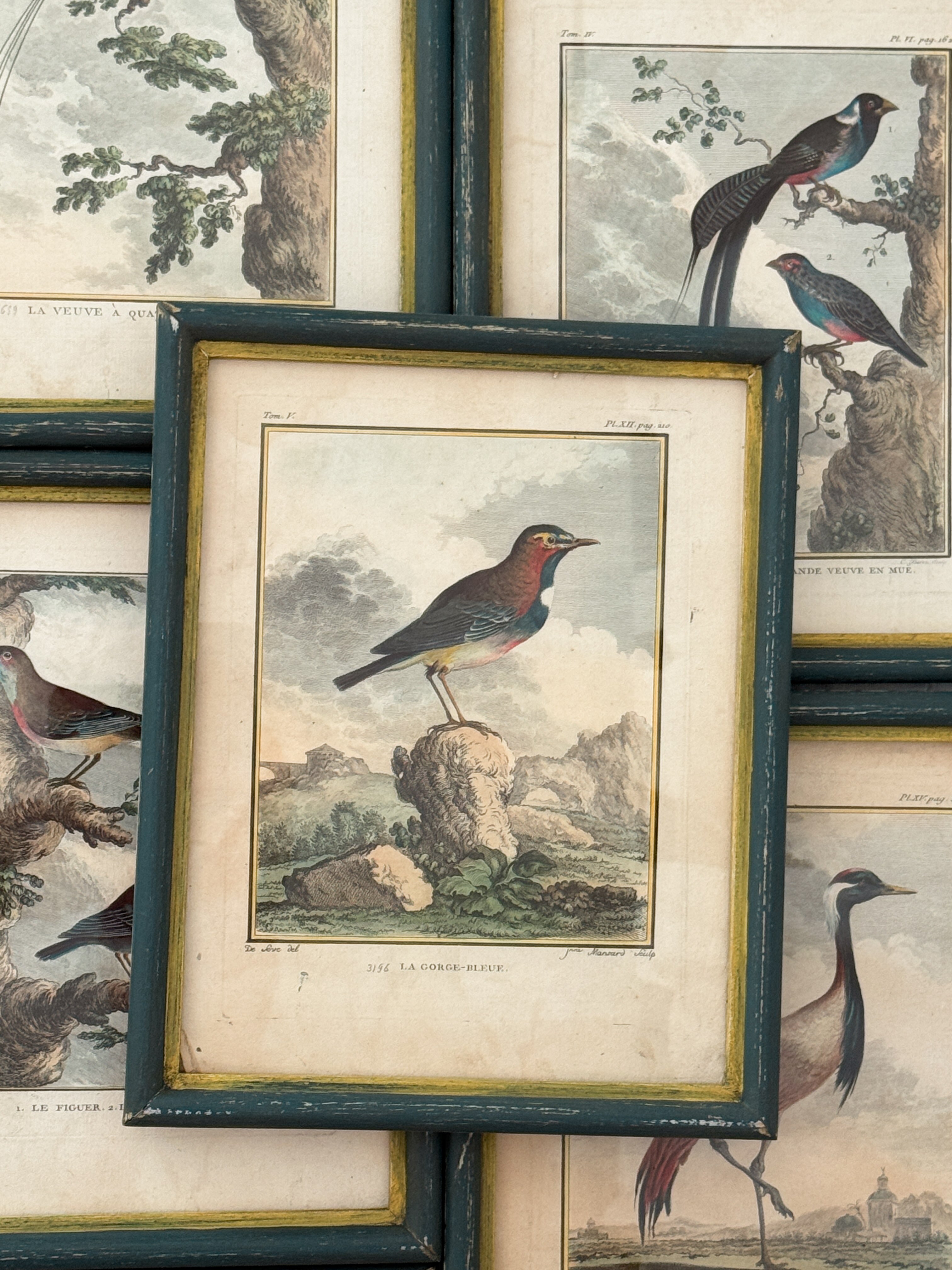
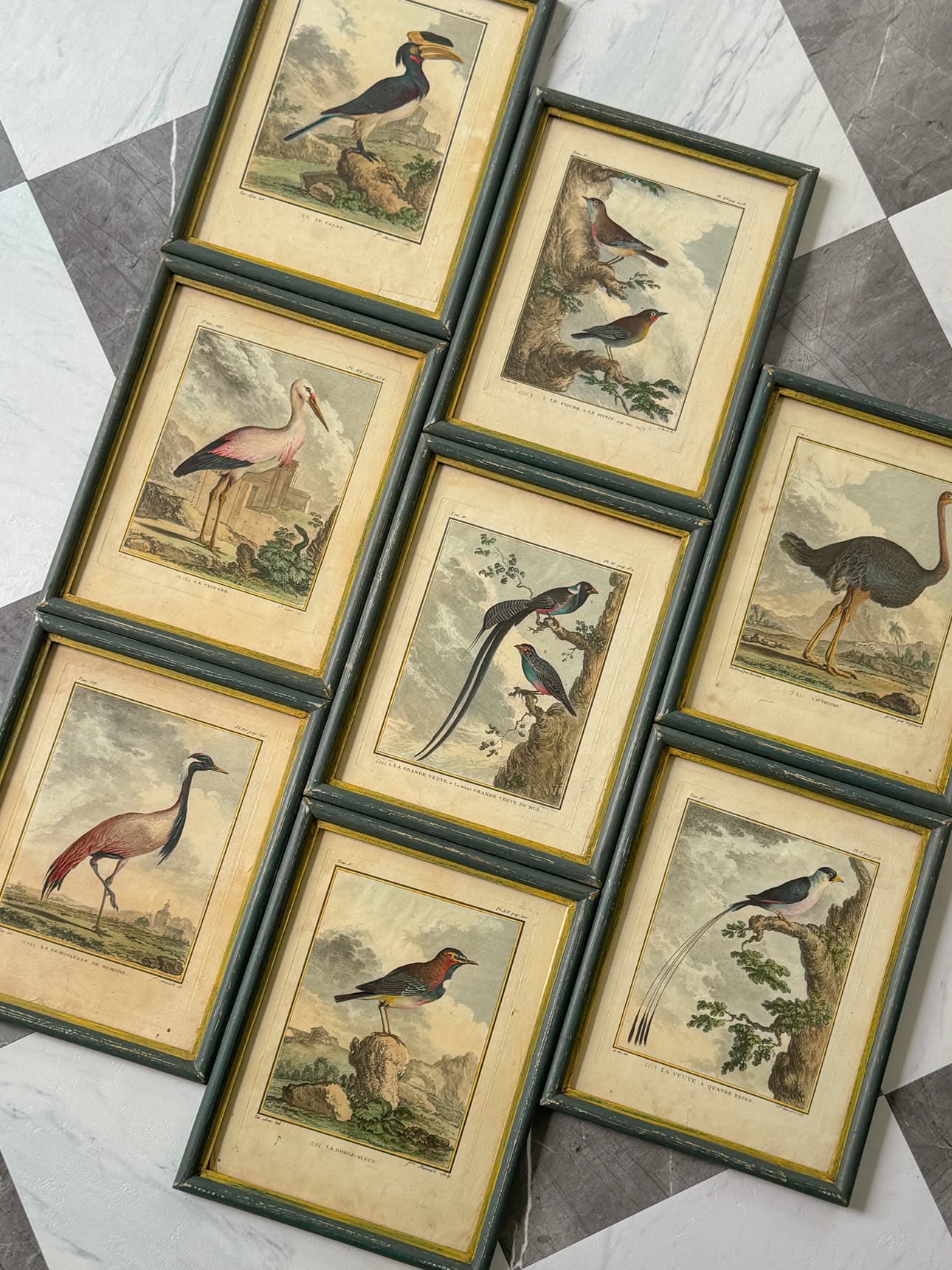
Antique French de Buffon Bird Engraving, La Gorge-Bleue, Hand Colored, 18th Century
Period
1770 to 1783, French
Size
9¼ x 11½ inches, framed
A hand colored copperplate engraving of the bluethroat, from Buffon's Histoire naturelle, drawn by Jacques de Sève and engraved by Jean Mansard. Marked pl. 3196.
A small bird perched on a rock in profile, the throat and breast carrying the rust and blue that give it its name, the back and wing in warm brown. The rock is drawn with real weight beneath it and the ground beyond falls away into a pale distance, so a bird a few inches long is given the setting of a landscape.
The paper has warmed to ivory with scattered foxing through the margins. The frame is painted blue gray with a yellow ochre inner fillet, distressed to bare wood at the corners and along the rails. Sold as found.
Historical Context
The bluethroat is a small migratory bird of northern Europe and Asia that winters in Africa and southern Asia. The blue on the throat belongs to the male and comes in with the breeding plumage, and the pattern within it varies by population, which is why the older literature carries the bird under several competing names. Buffon's project was in part an attempt to sort exactly this kind of confusion.
Georges-Louis Leclerc, comte de Buffon, ran the Jardin du Roi in Paris and gave the rest of his life to the Histoire naturelle, thirty-six volumes published between 1749 and his death in 1788, with eight more added afterward by his successors. He wrote it in French and aimed it at any educated reader, and the first edition sold out in six weeks and went on into English, German, Swedish, Italian and Russian. The nine volumes on birds were written with Guéneau de Montbeillard, and Jacques de Sève drew close to two thousand plates across the whole work.
Choose options